Luggage Forwarding in Japan With Kids: How We Sent Our Bags Between Cities
We stayed in six hotels while visiting seven destinations on our 14-day Japan trip with a 5-year-old, and we sent our bags ahead three times. Luggage forwarding, called takkyubin in Japan, meant we rode the trains with small bags instead of dragging suitcases through stations. This is how it worked for our family, where we used it, and what we'd tell you before you try it.
If you're still building your route, our 14-Day Japan Itinerary shows every stop, and What We Packed for Japan covers the bags we traveled with.
This post contains affiliate links. If you book through them, we may earn a small commission at no extra cost to you.
What Is Luggage Forwarding in Japan (Takkyubin)?
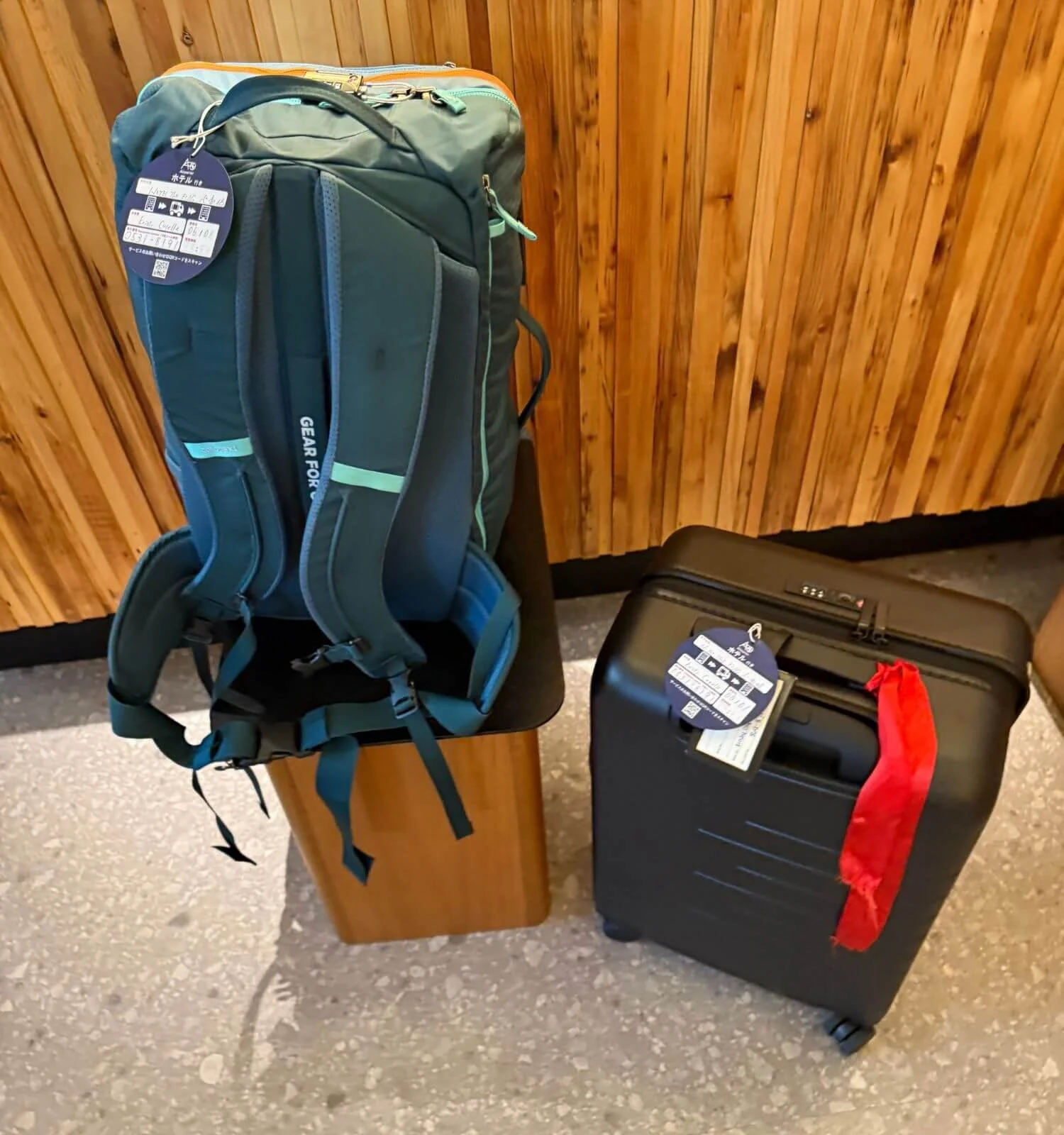
Luggage forwarding is a door-to-door delivery service for suitcases and travel bags. In Japan it's known as takkyubin (宅急便), and Yamato Transport, the company with the black cat logo, is the name most visitors run into. Sagawa Express and Japan Post offer similar services. You hand a bag to your hotel's front desk, and the carrier delivers it to the address you choose, usually the hotel you're moving to next.
Delivery between major cities generally takes one day, and some routes take two, so your bags won't necessarily arrive the moment you do. Yamato's standard service accepts bags up to 200 cm in combined length, width, and height and up to 30 kg each, which covers carry-on and standard-size suitcases. Limits and rules change, so confirm the details with your hotel.
Why We Used Luggage Forwarding With a 5-Year-Old
Japan's train stations mean stairs, transfers, and crowds, and we were already walking 20,000 steps or more every day with a child who sometimes needed to be carried. Sending our bags ahead kept our hands free for him and made travel days far less stressful.
We traveled carry-on only, so the bags we forwarded were small. Even so, they were more than we wanted to manage on a crowded platform with a tired kid. In our opinion, the service is inexpensive and well worth it.
Read more: Japan With Kids: Everything I Wish I Knew Before Our Trip
Where We Used Luggage Forwarding on Our Trip
We used it three times:
Tokyo to Kyoto, with a night in Hakone in between. We sent our bags straight to our Kyoto hotel and took only a small overnight bag to Hakone, which made the Romancecar ride and the Hakone Loop much easier.
Kyoto to Osaka, with a night in Miyajima in between. Our bags went ahead to Osaka while we took a small bag to Hiroshima and Miyajima.
Osaka to Tokyo, on our last leg. We sent our bags ahead so we did not have to carry them on the Shinkansen back to Tokyo, where we spent our last night near Haneda Airport.
How to Arrange Luggage Forwarding at Your Hotel
The process is simple once you know what to ask. Here's the order we'd follow:
Ask at check-in, not checkout. Hotels have different deadlines. Some accept your bags the morning you leave, and others need them a day ahead. Asking early avoids last-minute surprises.
Confirm your next hotel will accept the delivery. Staffed hotels usually can. Places without a front desk, such as some apartment rentals, may not be able to receive bags, so check first.
Have your next hotel's details ready. You'll need its name, address, and phone number, plus the name on your reservation and your arrival date.
Choose your delivery date. Aim for delivery on or before the day you check in, and leave a buffer if your schedule is tight.
Keep your receipt. It's your proof of shipment and has the number you'd need to track the bag.
Pack an overnight bag for the night in between. See the next section.
If your hotel can't handle it: Some convenience stores can also send luggage for you. Ask at the counter whether that location offers takkyubin, since it varies by store. Stores like these typically only send bags, they don't receive them, so you'll still need your next hotel's name, address, and phone number, and that hotel needs to be able to accept the delivery.
What to Pack in Your Overnight Bag
When your bags travel separately, whatever you need until they arrive has to go with you. Here's what we'd recommend keeping in an overnight bag for a family:
Passports and important documents
Medications and anything you'd miss if a bag were delayed
Phone chargers and a portable charger
A change of clothes and pajamas for each person
Toiletries for one night
Your child's comfort item and a few snacks
For us, one small overnight bag was enough for both Hakone and Miyajima.
Read more: What We Packed for Japan (Family of 3, 14 Days, Carry-On Only)
How Long Does Luggage Forwarding Take?
Between major cities, delivery is typically the next day, and some routes take two days. Remote regions can take longer. Because timing depends on the route and when you hand the bags over, we treat forwarding as something to arrange a day early, not a same-day fix. If your bags are still on their way when you reach the next hotel, that's exactly why the overnight bag matters.
How Much Does Luggage Forwarding Cost?
Rates depend on the size and weight of each bag and the route, so we won't quote a price that may change. We tracked what we paid, and you can see how it fit into our overall budget in What Our 14-Day Japan Trip Actually Cost.
Tips for Luggage Forwarding With Kids
Keep bags small. Carry-on sized bags are easier to handle if plans change and you end up carrying one yourself.
Label your bags and photograph your receipt. Put your next hotel's name on the bag, and keep a photo of the receipt on your phone.
Leave a buffer on travel days. Don't schedule a tight train connection right after dropping bags off.
Skip the oversized-bag hassle. Large suitcases on the Shinkansen can require reserving space in an oversized baggage area, and forwarding sidesteps that. Check the current JR rules before you go.
Don't forward what you can't replace. Keep passports, medication, and valuables with you.
Luggage Forwarding vs. Coin Lockers and Hotel Storage
Forwarding moves your bags to a different hotel. Lockers and hotel storage only hold them for a few hours. On our last day in Tokyo, we left our bags at our hotel's cloakroom so we could explore before heading to the airport, which we cover in our Haneda Airport hotel review. If you're changing cities, forward your bags. If you're sightseeing for the day and coming back, storage or a locker is usually enough.
Luggage Forwarding to and From the Airport
Major airports in Japan typically have counters that can send luggage to your hotel, and Yamato offers a dedicated Airport TA-Q-BIN service for bags headed to the airport. Recommendations for how many days ahead to send bags vary, so ask your hotel and check Yamato's current instructions before your flight. We stayed at a hotel connected to Haneda Airport Terminal 3 on our last night, so we handled departure day without using luggage forwarding.
Luggage Forwarding in Japan: FAQ
Can hotels in Japan send your luggage to your next hotel?
Many staffed hotels can arrange it. Ask at check-in, and confirm that your next hotel will accept the delivery.
How long does luggage forwarding take in Japan?
Usually the next day between major cities, and sometimes two days depending on the route. Remote regions can take longer.
Do you need to speak Japanese to use luggage forwarding?
No. The shipping form may be in Japanese, but hotel staff commonly help fill it out. Some of the forms we filled out were digital, and we just translated them through our browser. Have your next hotel's name, address, and phone number ready.
What size bags can you send?
Yamato's standard service lists a maximum of 200 cm in combined length, width, and height and 30 kg per bag. Confirm current limits with your hotel at the time of your visit.
Is luggage forwarding worth it with kids?
For us, yes. It kept our hands free for our 5-year-old and made every city change easier. If you're staying in one city or traveling with a single backpack each, you may not need it.
Can you forward luggage to an Airbnb or apartment rental?
Only if someone can accept the delivery. Hotels with a staffed front desk are the easiest, so check with your host before sending anything.
What if my hotel can't send my luggage?
Some convenience stores offer takkyubin, so ask at the counter. You'll need your next hotel's name, address, and phone number, and that hotel has to be able to accept the delivery.
Our Honest Take
It felt strange at first to hand over all of our things and trust they'd show up. But like most things we experienced in Japan, the service was trustworthy and efficient. We wouldn't hesitate to use it again, and it was our biggest travel hack of the trip. It was inexpensive for what it saved us, and we never had to wrestle suitcases through crowded stations with a tired 5-year-old. It does take a little planning: ask your hotel early, pack an overnight bag, and stay at places with a staffed front desk. If you're changing hotels several times, we'd do it again.
More From Our Japan Trip
Our 14-Day Japan Itinerary: Tokyo, Hakone, Kyoto, Hiroshima, Miyajima, Nara & Osaka
What We Packed for Japan (Family of 3, 14 Days, Carry-On Only)
How to Get Around Japan: A First-Time Visitor's Guide to Trains, Suica Cards, Google Maps & More
Where We Stayed in Japan: Honest Reviews of Our 6 Hotels (13 Nights as a Family)
Where to Stay Near Haneda Airport With Kids: Our Honest Hotel Review
Is Japan Good for Families? What We Actually Thought of Our Trip